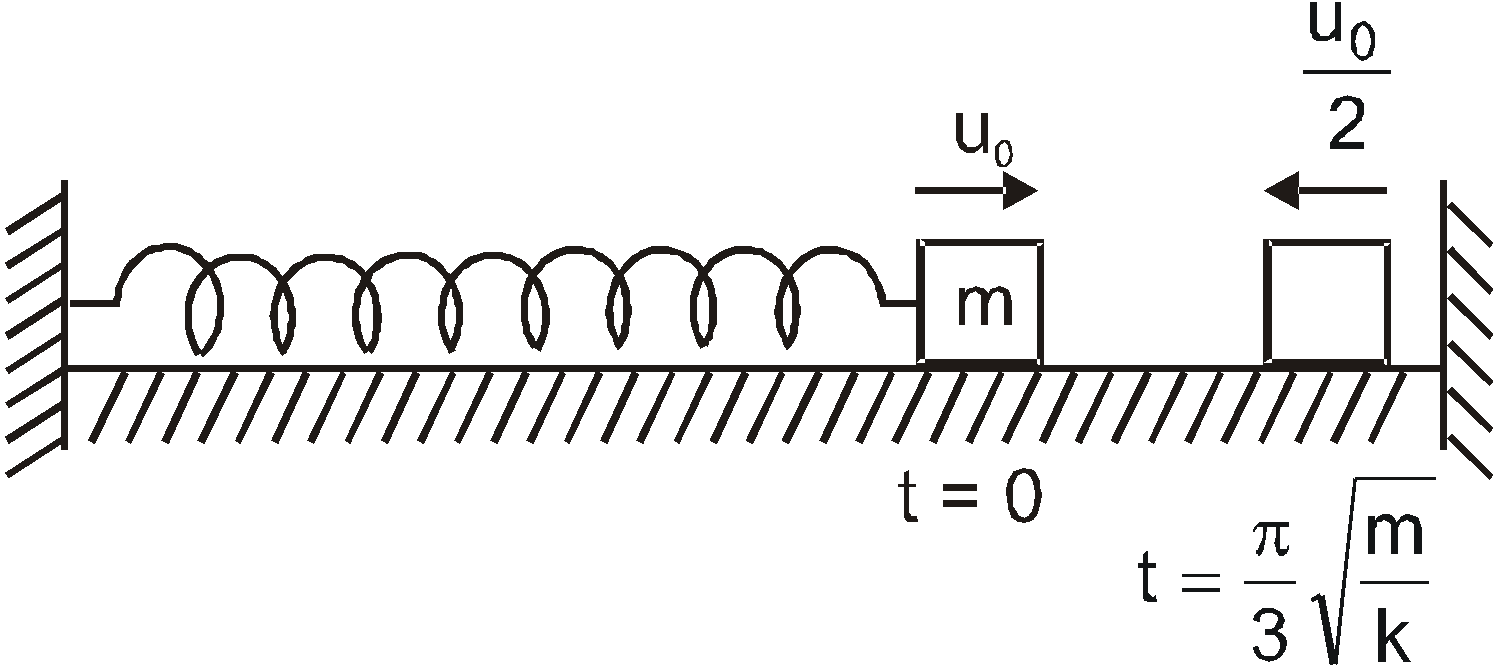
A particle of mass m is attached to one end of a mass–less spring of force constant k, lying on a frictionless horizontal plane. The other end of the spring is fixed. The particle starts moving horizontally from its equilibrium position at time t = 0 with an initial velocity u 0 . When the speed of the particle is 0.5 u 0 , it collies elastically with a rigid wall. After this collision:
A
the speed of the particle when it returns to its equilibrium position is u 0 .
B
the time at which the particle passes through the equilibrium position for the first time is  .
.
.
C
the time at which the maximum compression of the spring occurs is  .
.
.
D
the time at which the particle passes throughout the equilibrium position for the second time is  .
.
.
Text Solution
Verified by ExpertsThe correct answer is:
CHECK THE SOLUTION.
(a, d)
x = A sinꞷt
v = Aꞷcosꞷ t = 
⇒ cosꞷt = 
ꞷt =  ⇒ t =
⇒ t =  =
= 

for
time = 
 +
+  =
= 
for
time =  +
+  =
= 
Prepare Smarter with CGP Edu
Get practice questions, solutions, and test series in one place.
Write a Review
Share your experience with this question and solution.
Commentary
Send your comment, doubt, correction, or feedback to admin.
Similar Questions
Explore conceptually related problems
A mass M, attached to a horizontal spring, executes SHM with a amplitude A 1 . When the mass M pass…
Two particles are executing simple harmonic motion of the same amplitude A and frequency ꞷ along th…
If a simple pendulum has significant amplitude (up to a factor of 1/e of original) only in the peri…
The amplitude of a damped oscillator decreases to 0.9 times its original magnitude is 5s. In anothe…
A particle moves with simple harmonic motion in a straight line. In first τ s, after starting from …
For a simple pendulum, a graph is plotted between its kinetic energy (KE) and potential energy (PE)…